
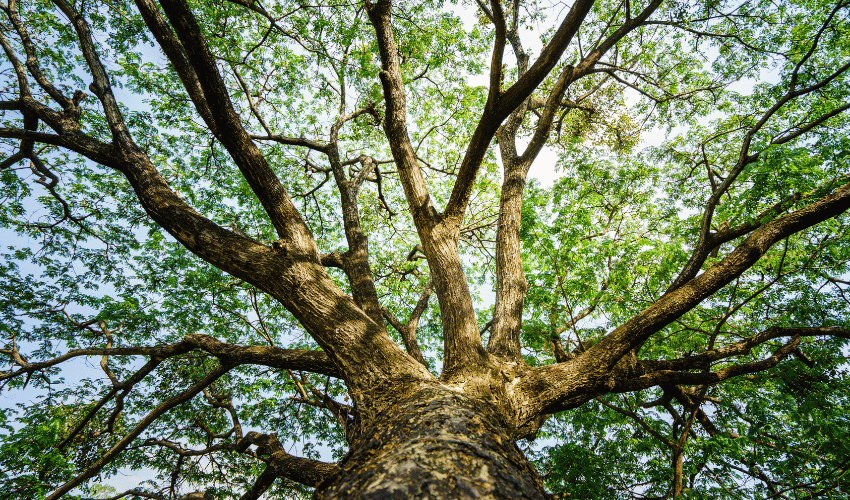
As Hudson Valley homeowners pick up the remnants of last month’s nor’easter, some may be noticing more than fallen branches in their yards. The September storm knocked out power to more than 19,000 homes and businesses across the Hudson Valley, and even if your tree escaped obvious damage, those strong winds may have exposed cracks, splitting stems, weak branch unions, and other structural problems that may require tree cabling and bracing.
Finding one of these problems doesn’t automatically mean the tree has to be removed. Depending on the tree and the extent of the damage, cabling or bracing may provide additional support and help reduce stress on weakened areas.
Key Takeaways
- Tree cabling uses flexible support between limbs or stems, while bracing uses rigid rods to reinforce weak or splitting unions.
- An arborist may recommend structural support for codominant stems, weak unions, cracks, overextended limbs, or certain types of storm damage.
- Cabling and bracing can reduce excessive movement and stress, but they cannot repair decay or eliminate the possibility of tree or branch failure.
- Structural support may allow some mature or valuable trees to be retained instead of removed.
- Cabling and bracing systems require ongoing inspection as the tree grows and conditions change.
What Is Tree Cabling and Bracing?
Tree cabling and bracing are supplemental support methods arborists use to reduce stress on structurally weak parts of a tree. Depending on the problem, an arborist may recommend cabling, bracing, or a combination of the two.
These systems don’t repair damaged wood or correct a tree’s underlying structure. Instead, they provide additional support intended to reduce movement or reinforce a vulnerable area.
Hill Treekeepers provides cabling and bracing services as part of our professional arborist services throughout the Hudson Valley.
What Is the Difference Between Tree Cabling and Bracing
Tree cabling and bracing both provide supplemental structural support, but they support weak areas of a tree in different ways:
- Cabling uses high-strength cables installed between major limbs or stems, typically higher in the canopy. By limiting excessive movement and helping redistribute forces on weak branch unions, cables can provide additional support without being especially noticeable. Once the tree is fully leafed out, you may hardly see them at all.
- Bracing, on the other hand, uses rigid, threaded rods installed through weak, cracked, or splitting unions. Because the rods restrict movement directly at the weakened area, bracing is more invasive than cabling and is generally used when more rigid support is needed. In some cases, an arborist may use both systems together.
Whether a tree needs cabling, bracing, or a combination of the two depends on the type and location of the structural weakness. An arborist can evaluate the tree, determine whether supplemental support is appropriate, and identify which system will best address the problem.
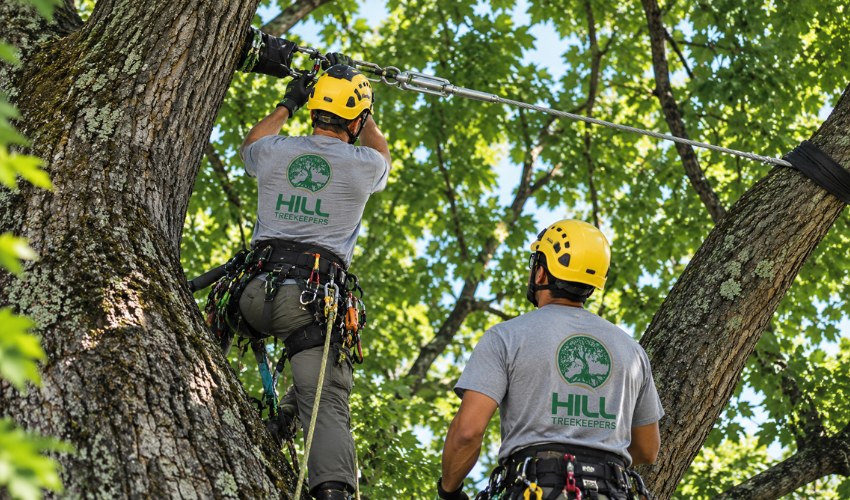
Cables sit higher in the canopy and limit how far supported limbs can move apart, often without being noticeable once the tree leafs out.
When Does a Tree Need Cabling or Bracing?
An arborist may recommend cabling or bracing when a tree has a structural weakness but is otherwise a good candidate for preservation. Common reasons include:
- Codominant stems or weak branch unions that may be vulnerable to splitting
- Cracks or separation where major limbs or stems meet
- Long, heavy, or overextended branches that place additional stress on the tree
- Certain types of storm damage that have weakened limbs or branch unions
- Mature or valuable trees with structural weaknesses where preservation may be possible
If you notice one of these problems while inspecting your trees, have an arborist evaluate it rather than assuming the tree needs support or needs to come down.
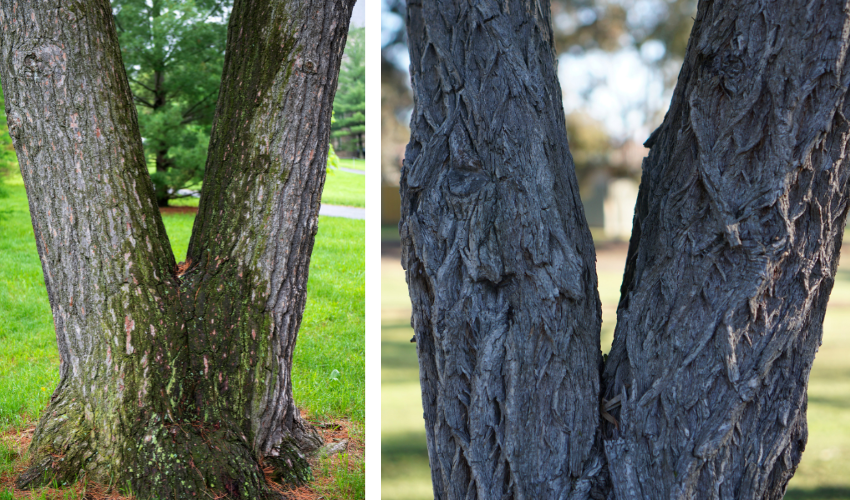
Codominant stems and cracked unions are common reasons an arborist may recommend cabling or bracing.
What Are the Benefits of Tree Cabling and Bracing?
For trees that are appropriate candidates, supplemental support can address structural weaknesses while allowing the tree to remain in the landscape. Here are five potential benefits of tree cabling and bracing.
1. Reduce Movement at Weak Points
Wind causes branches and stems to sway, twist, and pull against their connections. Cabling limits how far supported parts of the tree can move, reducing the forces placed on weak unions during storms and high winds.
This is especially useful for codominant stems, heavy limbs, and other areas where repeated movement can worsen an existing structural weakness.
2. Lower the Risk of Large Branch or Stem Failure
A weak union doesn’t necessarily mean failure is imminent, but the consequences can be significant when a large limb hangs over a home, driveway, patio, or other frequently used area.
Cabling and bracing provide supplemental support to reduce the likelihood of certain types of failure. They can’t eliminate risk entirely, but they can be one part of managing it.
[blockquote] WARNING: No cabling or bracing system can guarantee that a tree or branch won’t fail. Supported trees still require monitoring and periodic professional inspection.
3. Keep More of the Canopy Intact
A weak limb doesn’t always need to be removed entirely. If the branch is healthy enough to keep, an arborist may use selective pruning to reduce its weight and cabling to provide extra support. This approach can address the structural concern without unnecessarily removing a large limb or significantly altering the tree’s canopy.
4. Provide Extra Support During Weather Events
Trees in the Hudson Valley have to contend with thunderstorms, strong winds, heavy rain, snow, and ice (all of which can increase forces on already weak limbs and unions).
Cabling and bracing don’t storm-proof a tree, but they can provide additional support in areas an arborist has identified as structurally vulnerable. This can be particularly valuable for mature trees exposed to repeated seasonal weather.
5. Give Mature or Significant Trees Another Option Besides Removal
When a mature tree develops a structural weakness, removal isn’t always the only option. If the tree is otherwise healthy enough to keep, cabling, bracing, pruning, and ongoing monitoring may manage the problem while keeping the tree in the landscape. An arborist can evaluate the tree and determine whether structural support is appropriate or removal is the safer choice.
This is especially valuable for mature trees that would take decades to replace. Keeping an established tree also means holding onto benefits that extend beyond its appearance, including:
- Shade and Energy Savings: Strategically placed trees can reduce the energy needed to cool a home, especially during hot summer months.
- Property Value: Healthy, established trees can add value to your property while improving your landscape’s overall appearance.
- Wildlife Habitat: Mature trees provide food, shelter, and nesting areas for birds and other wildlife throughout the Hudson Valley.
How Long Do Tree Cabling and Bracing Systems Last?
There isn’t one lifespan that applies to every tree cabling or bracing system. How long a system lasts depends on its materials, installation, the tree’s growth and condition, environmental exposure, and changes in the tree’s structure.
That’s also why installing a support system isn’t the end of the process. The tree and the system need to be reassessed over time.
Do Tree Cabling and Bracing Systems Need to Be Inspected?
Yes. Trees with supplemental support systems should be inspected periodically to make sure the system and the tree are still performing as intended.
Trees continue to grow after cables and braces are installed, which can change their structure. Storms, new damage, decay, changes in branch weight, and wear on system components may also affect the original support plan.
An arborist can evaluate the tree, check the condition and placement of the hardware, look for changes in the supported portions of the tree, and determine whether the system needs adjustment, replacement, or another type of tree care.
An additional inspection may also be warranted after a significant storm or if you notice a new crack, split, lean, broken branch, or other structural change.
Does Tree Cabling and Bracing Replace Pruning?
No. Cabling and bracing provide supplemental support, while pruning addresses the tree’s canopy and individual branches. Depending on the tree, an arborist may recommend using the two services together.
Professional pruning may reduce weight on an overextended limb, remove dead or damaged branches, or remove canopy portions that aren’t appropriate to retain. Cabling or bracing can then provide support where a structural weakness remains.
The right combination depends on the tree rather than a standard treatment applied to every structural problem.
When Is Tree Removal Better Than Cabling or Bracing?
Cabling and bracing can support a tree with certain structural weaknesses, but they can’t make every damaged or declining tree safe to keep.
Removal may be the better option when a tree has extensive decay, severe structural damage, major root problems, or significant storm damage that a support system can’t adequately address.
That’s why the decision shouldn’t begin with “Does this tree need a cable?” It should begin with an evaluation of the entire tree to determine whether it can be safely supported or needs another solution.
Frequently Asked Questions About Tree Cabling and Bracing
Can you cable a tree that is already splitting?
Sometimes. Cabling and bracing may support a tree with a crack or split, but it depends on the damage’s location and severity and the condition of the rest of the tree. An arborist should evaluate the tree before deciding whether structural support is safe.
What does tree cabling and bracing cost?
The cost of tree cabling and bracing depends on the size of the tree, the location and severity of the structural weakness, the type of support system needed, and how easily the arborist can access the installation area. Some trees need a single cable, while others may require multiple cables, bracing rods, or a combination of both. An arborist will need to evaluate the tree before providing an accurate estimate.
Can tree cables break?
Yes. Tree cables and their attachment points can wear, loosen, or become damaged over time. The tree itself also continues to grow and change, which can affect how well the original support system works. Regular inspections allow an arborist to check the hardware, evaluate changes in the tree, and determine whether the system needs to be adjusted or replaced.
Can cabling stop a tree from falling?
No. Cabling is designed to provide supplemental support to specific limbs, stems, or weak unions; it cannot guarantee that an entire tree won’t fall. If there are concerns about the stability of the whole tree, an arborist should evaluate its trunk, roots, structure, and surrounding conditions.
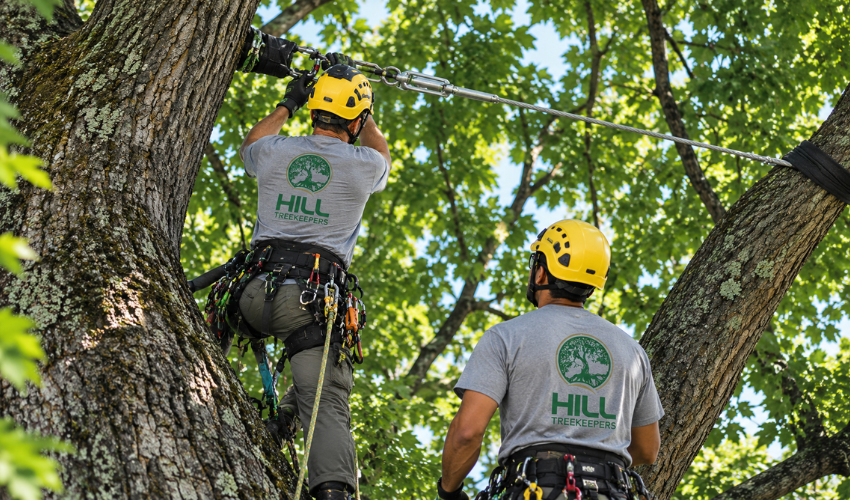
Supported trees keep growing, so cables and braces need periodic inspection to make sure the system still fits the tree.
Find Out If Cabling or Bracing Is Right for Your Tree
Tree cabling and bracing can provide additional support for weak unions, splitting stems, heavy limbs, and other structural concerns. By limiting movement and reinforcing vulnerable areas, these systems can reduce the risk of certain types of failure and may allow mature trees to remain safely in the landscape. However, structural support isn’t appropriate for every tree and requires ongoing inspection as the tree grows and changes.
Hill Treekeepers can evaluate your tree and determine whether cabling, bracing, pruning, or another approach is appropriate. If you’re concerned about a tree on your Hudson Valley property, call 914-306-6056 or request a quote online to schedule an evaluation.
Share this online!

Get the highest quality of tree services for residential and commercial properties in the Hudson Valley area. We look forward to working with you!
TOPICS
Recent Articles





Don't Miss the Next Update!
Join the thousands of smart Hudson Valley residents who get the monthly newsletter from Hill Treekeepers. It's full of helpful information you won't want to miss!

