

Across the Hudson Valley, homeowners are paying closer attention to their beech trees — and for good reason. Beech leaf disease has spread throughout much of New York, putting mature beech trees under increasing pressure and making symptoms like curled leaves, dark striping, thinning canopies, and branch dieback much harder to ignore.
But one of the biggest mistakes homeowners make is assuming every unhealthy beech tree has beech leaf disease. In reality, several different pests, fungal diseases, and stress conditions can produce similar symptoms, especially early in the growing season. Knowing which symptoms match which problem is what helps determine whether your beech tree can be treated, monitored, or may already be in serious decline.
Key Takeaways
- Beech leaf disease is now confirmed in all three of Hill’s service counties (Orange, Dutchess, and Ulster) and shows up as dark bands between leaf veins from May through October.
- Curling or leathery beech leaves can mean BLD, but they can also mean aphid damage or anthracnose, especially after a cool, wet Hudson Valley spring.
- White woolly patches on the bark point to a different condition entirely, beech bark disease, and the same tree can have both BLD and BBD at the same time.
- Thinning canopy and branch dieback are late-stage signs of multiple possible problems and warrant a professional arborist assessment rather than a homeowner guess.
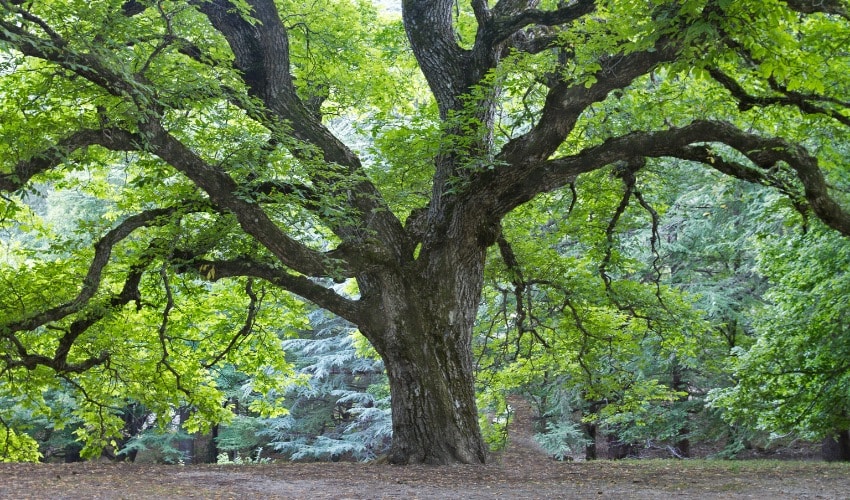
Healthy mature beech trees are a defining part of many Hudson Valley landscapes, but several emerging diseases are putting long-term canopy health under pressure.
Why Are There Dark Stripes on My Beech Leaves?
Dark stripes between the veins of beech leaves are the signature symptom of beech leaf disease (BLD), and once you’ve seen them, they’re hard to mistake for anything else.
The bands run between the secondary veins, giving the foliage a striped look that’s most obvious from below. Stand under the tree on a sunny day and look up, as the markings show through when light passes through the leaf. Early in the season, they appear darker green than the surrounding tissue, then shift to yellow by fall. Lower branches usually show symptoms first and most heavily.
On copper-leaf European beech, the banding is harder to spot against the dark foliage and may instead read as a generally blighted appearance. And in the Hudson Valley, beech leaf disease isn’t a future concern; it’s a current one. BLD was confirmed in Orange and Dutchess counties in 2021 and in Ulster County in 2023. You can expect visible symptoms from leaf-out in May through October, with most homeowners first noticing the dark stripes in May or June.
IMPORTANT: Beech leaf disease currently has no known cure, and once canopy thinning begins, decline can accelerate quickly. However, research-stage trunk injection treatments are showing encouraging results for some high-value landscape trees when caught early enough.
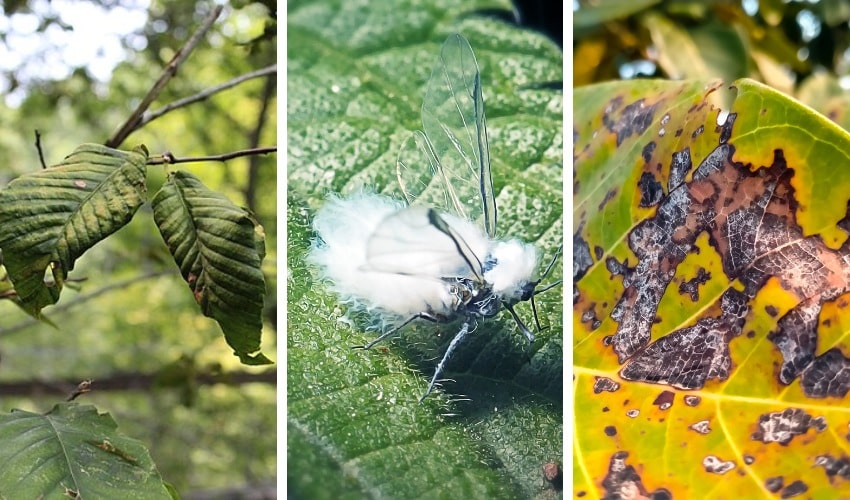
Curling beech leaves can have several different causes, including aphids, anthracnose, and advanced beech leaf disease, depending on the accompanying symptoms. Photo courtesy of usfs_Eastern_Region, Public domain, via Wikimedia Commons.
Why Are My Beech Tree Leaves Curling?
Curling beech tree leaves can be caused by advanced beech leaf disease, beech leaf-curling aphids, or anthracnose; the small details on the leaf are what tell you which one you’re dealing with.
Advanced Beech Leaf Disease
As BLD progresses through the season, infected leaves curl and develop a thick, leathery, almost crispy texture. They may wrinkle or cup, and a stressed tree sometimes pushes out a small, pale second flush of leaves later in the summer to compensate. The distinguishing feature is that BLD curling almost always shows up alongside the dark interveinal banding.
Aphid Damage (the Most Common Look-Alike)
Aphids are the most common reason beech leaves curl, and the damage is usually easy to spot up close: the leaf margins roll inward, often tightly. If you uncurl one of the affected leaves, you’ll usually find the aphids themselves or their cast skins inside.
The key difference from BLD is the absence of any banding between the veins, just the rolled edges, with otherwise normal-looking leaf tissue. Aphid damage is mostly cosmetic and rarely causes long-term harm to an established tree.
Anthracnose
Anthracnose is a fungal disease that causes beech leaves to curl at the edges along with brown or black lesions, often round and ringed with a yellow halo, on the leaf surface. Unlike BLD, the marks are discrete spots and lesions rather than continuous bands. The disease is most common after a cool, wet spring, exactly the kind the Hudson Valley delivers in many years.
What Are the White Fuzzy Patches on My Beech Tree’s Bark?
White fuzzy patches on beech bark are colonies of beech scale insects covered in protective wax, and they’re usually the first visible sign of beech bark disease (BBD).
The patches typically appear as small white cottony clusters on the trunk and larger limbs, especially in rough bark crevices, under moss or lichen, and around branch unions.
Once the scale insects create feeding wounds in the bark, Neonectria fungi enter through those openings and begin the second stage of the disease. As BBD progresses, trees may develop:
- Bark cankers
- Red-brown sap or oozing areas
- Thinning canopy
- Branch dieback
- Structural weakness known as “beech snap”
Unlike aphid damage or minor leaf issues, beech bark disease is a serious long-term decline problem that has affected Northeastern forests for decades.
Beech Bark Disease vs. Beech Leaf Disease
Beech bark disease (BBD) and beech leaf disease (BLD) are completely different conditions caused by different organisms, but homeowners often confuse them because both lead to canopy decline over time.
The simplest distinction is this:
- BBD affects the bark and starts with white woolly scale insect colonies
- BLD affects the leaves and starts with dark striping between leaf veins
Unfortunately, the same tree can have both diseases simultaneously. When that happens, the combined stress often accelerates decline much faster than either condition alone.
Why Is My Beech Tree’s Canopy Thinning?
A thinning canopy is usually a late-stage symptom rather than a diagnosis itself. By the time a mature beech begins looking sparse from the ground, more than one stress factor is often involved.
Common causes of canopy thinning in Hudson Valley beech trees include:
- Advanced beech leaf disease
- Beech bark disease
- Drought stress
- Root damage or soil compaction
- Compound stress from multiple overlapping problems
Why Late-Stage Symptoms Are Hard to Self-Diagnose
Late-stage symptoms on a beech are hard to self-diagnose because a sparse canopy can mean several different things, and the causes often overlap. In late-stage BLD, bud death prevents the tree from producing a normal volume of new leaves. Conversely, in advanced BBD, cankers can girdle limbs or sections of the trunk and restrict nutrient flow.
Finally, environmental stress — particularly the dry summers we’ve seen in the Hudson Valley in recent years — can also thin out the crown on its own, and beech roots are notoriously shallow, which makes the species especially drought-prone.
A drought-stressed beech typically shows leaf scorch, browning at the leaf margins and tips, along with wilting and premature leaf drop. What it doesn’t show is the dark interveinal banding of BLD or the white woolly bark patches of BBD. The right response is deep watering and a good layer of mulch over the root zone, not fertilizer, which pushes growth a stressed tree can’t support.
BLD also progresses faster in trees already weakened by drought or other stressors, so compound problems are the rule with mature beeches in this region, not the exception.
Why Canopy Thinning Is One of the Hardest Symptoms to Diagnose
Canopy thinning is one of the hardest beech symptoms to diagnose without arborist expertise because several different problems can produce a similar sparse, declining appearance from the ground. Advanced beech leaf disease, beech bark disease, drought stress, root damage, and soil compaction can all reduce canopy density over time, especially in mature trees.
At this stage, the visible symptoms often overlap enough that accurate diagnosis depends on evaluating the leaves, bark, root zone, and overall pattern of decline together rather than focusing on a single symptom in isolation.
Frequently Asked Questions About Beech Tree Health
Can a beech tree recover from beech leaf disease?
As of 2026, there is no cure for BLD. Saplings typically die within two to five years and mature trees within six to ten years of infection, though research-stage treatments, including trunk-injected fungicides applied after full leaf expansion, are showing promise for slowing the disease in high-value trees. A Certified Arborist can advise whether treatment makes sense for your specific tree.
Should I report a suspected case of beech leaf disease?
Yes, NYSDEC tracks BLD spread through New York and welcomes reports through the iMapInvasives reporting tool. Even though BLD is already confirmed in Orange, Dutchess, and Ulster counties, individual reports help the state map severity and progression year over year.
When should I inspect my beech trees for signs of disease?
Most leaf symptoms become easiest to spot between May and midsummer after full leaf expansion. Bark-level symptoms, like beech scale insects or cankers, can often be seen year-round. Regular inspections during spring and summer make it easier to notice changes before decline becomes severe.
Are some beech trees more resistant than others?
Researchers are studying why some individual beech trees appear more tolerant of BLD or beech bark disease than others, but no beech species is currently considered fully resistant. For homeowners, maintaining species diversity across the landscape is generally a safer long-term strategy than relying on a single tree species.
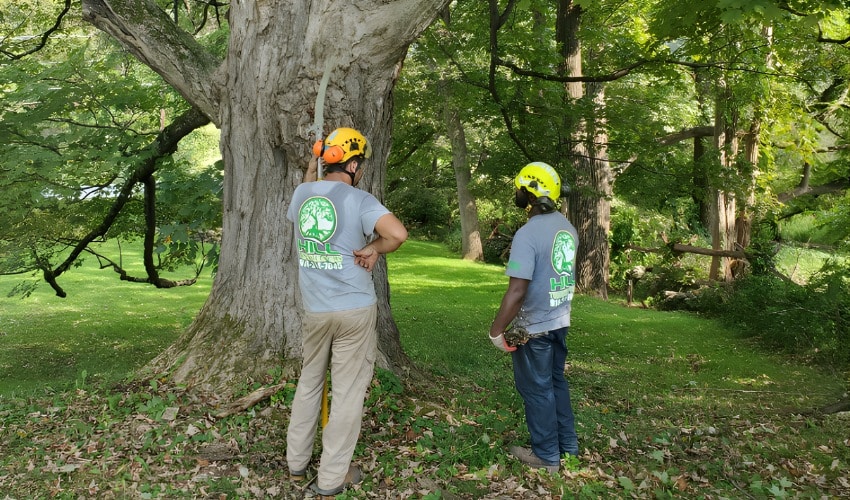
Diagnosing declining beech trees often requires evaluating the canopy, bark, root zone, and progression of symptoms together rather than focusing on one issue in isolation.
When Beech Trees Start Declining, Get Accurate Diagnosis from Hill Treekeepers
The sooner a beech tree problem is correctly identified, the more options you usually have. Some issues are mostly cosmetic, while others can permanently weaken the tree or accelerate decline over just a few growing seasons.
If you are worried about your beech trees this year, the team at Hill Treekeepers is here to help. Our arborists can inspect your beech tree, determine what problem is, and start a treatment program to try to save your tree. Call us today at 914-306-9069 or request a quote online to get help with your beeches.
Share this online!
Get the highest quality of tree services for residential and commercial properties in the Hudson Valley area. We look forward to working with you!
TOPICS
Recent Articles



Don't Miss the Next Update!
Join the thousands of smart Hudson Valley residents who get the monthly newsletter from Hill Treekeepers. It's full of helpful information you won't want to miss!

