
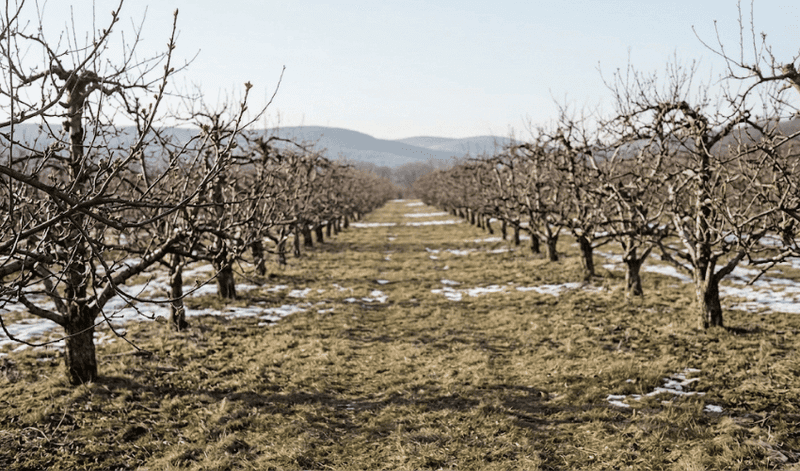
In the Hudson Valley, November’s a good time to book a dormant oil application service, since the spray window won’t open until buds start moving in the spring. A dormant oil application service protects fruit trees from overwintering scale and mites; it’s only effective when the oil reaches those pests at the right bud stage and covers every part of the tree. Miss that stage, skip something, or spray right before a freeze and the oil won’t do much.
Whether you hire a professional or spray yourself depends on how precisely you can manage everything.
Key Takeaways
- Oil smothers overwintering scale and mites on contact, so it works only when it reaches them at the right bud stage.
- Timing follows bud stage, not the calendar: scale control runs from silver tip through half-inch green, and European red mite control from green tip through half-inch green (tight cluster if mites have been a problem).
- A certified applicator adds block-by-block bud-stage timing, calibrated full-block coverage, and a scouting-first decision about whether to spray at all.
- Professional application matters most on larger trees and blocks, in narrow windows, and at properties where no one is on site.
- Oil does not control codling moth, apple maggot, or borers, so it is one step in a year-round orchard care plan.
What Is Dormant Oil?
Dormant oil is a horticultural oil sprayed on fruit trees in late winter or early spring to smother pests that overwinter on the bark and buds. It’s effective because scale needs more oxygen as it breaks dormancy and temperatures climb. That’s why timing matters so much.
Scales and Mites
In orchards throughout the Hudson Valley, the main targets of dormant oil are scale and mites. There are a few reasons why:
- Regional Pressure: One regional entomologist found San Jose scale in nearly every orchard he visited over ten years.
- Fast Buildup: A single female produces roughly 400 crawlers per generation.
- Low-Input Fit: Oil is widely used for scale in organic orchards, which matters if you manage your land for soil and ecosystem health.
What Oil Doesn’t Control
There are a few common orchard problems that oil doesn’t control, so it can’t carry a program by itself for things like:
- Codling moth
- Borers
- Cherry fruit fly
- Powdery mildew
- Apple maggot
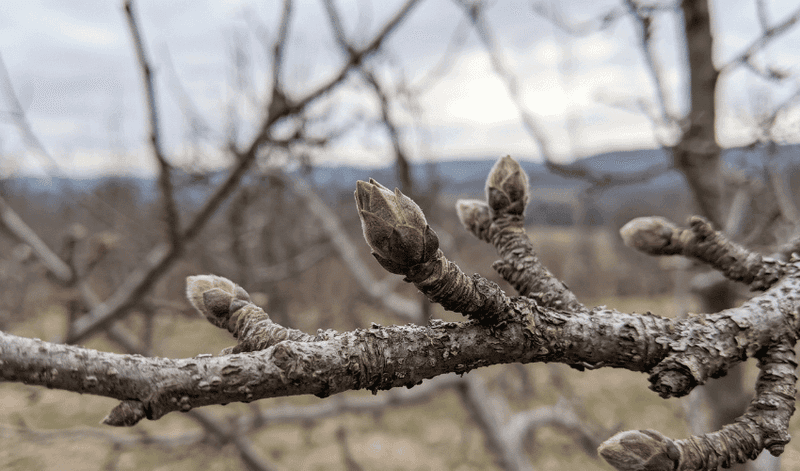
Bud stage, not the calendar, decides when oil can go on, and each stage allows a lower oil rate than the last.
When Should Dormant Oil Be Applied?
Dormant oil should be applied from the latter part of winter to early spring, depending on the bud stage instead of a specific date on the calendar. Bud stages vary from silver tip to green tip, half-inch green, tight cluster, and pink. Each pest has its own best window:
- European Red Mite: Green tip through half-inch green, plus tight cluster if mites have been a problem
- San Jose Scale: Silver tip through half-inch green
The windows are so narrow because buds rapidly advance and freezes can show up without warning; oil applied within 48 hours of a freeze can injure trees and fruit. Since each bud stage allows a lower oil rate than the last, a late start can limit your options.
What Does a Certified Dormant Oil Application Service Do Differently?
A certified dormant oil service adds a few things that are difficult to reproduce, especially at the scale of an orchard:
- Precise Timing: Bud stage is tracked block by block, since blocks don’t always reach the same stage on the same day, and forecasts are checked before and after each spray.
- Calibrated Coverage: Spray volume and travel speed are matched to the size of the trees, because excellent coverage is essential for oil to smother mite eggs and scale.
- Scouting-First Decisions: Oil goes on only if the orchard needs it. With no pest history, it usually isn’t worth applying.
Before booking an application from anyone, ask them about how they decide timing, what they do when a freeze is in the forecast, how they cover the entire tree and block, whether their sprayer is calibrated, and how they space oil from fungicide sprays. After that, confirm they’re certified by the New York State DEC and that they scout before deciding to spray in the first place.
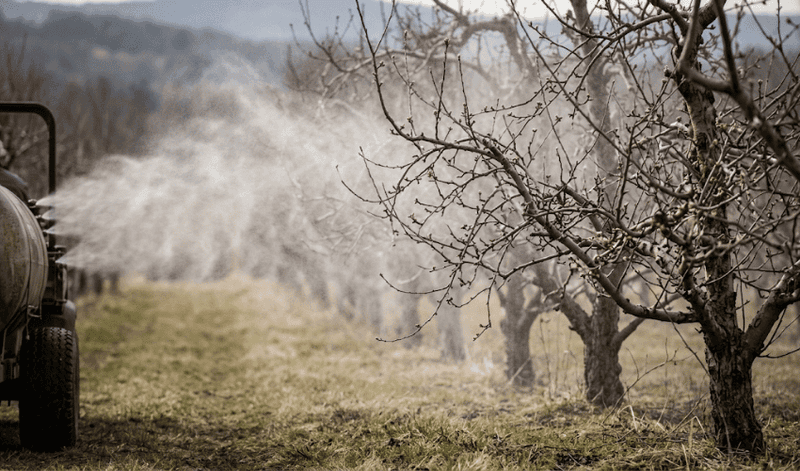
Oil only works on the scale and mite eggs it actually reaches, so full coverage of every branch matters.
Will Professional Application Really Make a Difference?
Professional application really makes a difference when:
- The orchard is large or the trees are tall
- Narrow windows leave minimal room for timing errors
- Part-time or second homes don’t have anyone around to keep an eye out for freezes
Cost is determined by the same things (number of trees, size, and accessibility). If you have a few small, easily reachable trees and can keep track of bud stage and the weather, it can make sense to spray them yourself.
How Does Dormant Oil Fit Into a Complete Orchard Care Program?
Dormant oil is the initial step of the season-wide plan. Scale that survives in protected spots on the canopy can still produce crawlers in June, so the scouting you do now also lets you know what to keep an eye on. A full orchard care plan includes diagnosis and pruning, and takes into account that certain species (e.g., codling moth, apple maggot, and borers) require their own timing and tactics.
Our team at Hill Treekeepers, which cares for orchards around Gardiner, Marlboro, and Milton, includes ISA Certified Arborists, so you know your trees will be expertly cared for.
Frequently Asked Questions About Dormant Oil
Can dormant oil still go on after buds start to open?
Yes, through pink, but the rate drops as buds advance: roughly 2% through half-inch green, 1% at tight cluster, and 0.5% at pink. Follow the product label and current Cornell Tree Fruit Guidelines for exact rates
How do I check my trees for scale?
Look at the bark of twigs and branches for small, dark, roughly circular covers, since San Jose scale spends the winter on bark in what is called the black-cap stage. If you aren’t sure what you are seeing, an arborist can confirm it before you book.
Do I need a license to hire someone to apply dormant oil in New York?
The person you hire does. New York treats a for-hire pesticide application as commercial work that requires certification, so ask to see it before you book. Property owners treating their own trees are often outside those business rules, but check DEC guidance for your situation.
Can dormant oil be combined with other sprays?
Usually, there’s no benefit, since results vary on whether adding insecticides to oil improves control. Keep oil away from captan, which shouldn’t be applied within 10 days of an oil spray, and check the label for sulfur, which can require a longer gap.
Schedule Your Dormant Oil with Hill Treekeepers Today
Buds start moving before you expect, and when they do, the window also closes. Request a quote now, and we’ll get you scheduled for an orchard care assessment.
Share this online!

Get the highest quality of tree services for residential and commercial properties in the Hudson Valley area. We look forward to working with you!
TOPICS
Recent Articles



Don't Miss the Next Update!
Join the thousands of smart Hudson Valley residents who get the monthly newsletter from Hill Treekeepers. It's full of helpful information you won't want to miss!